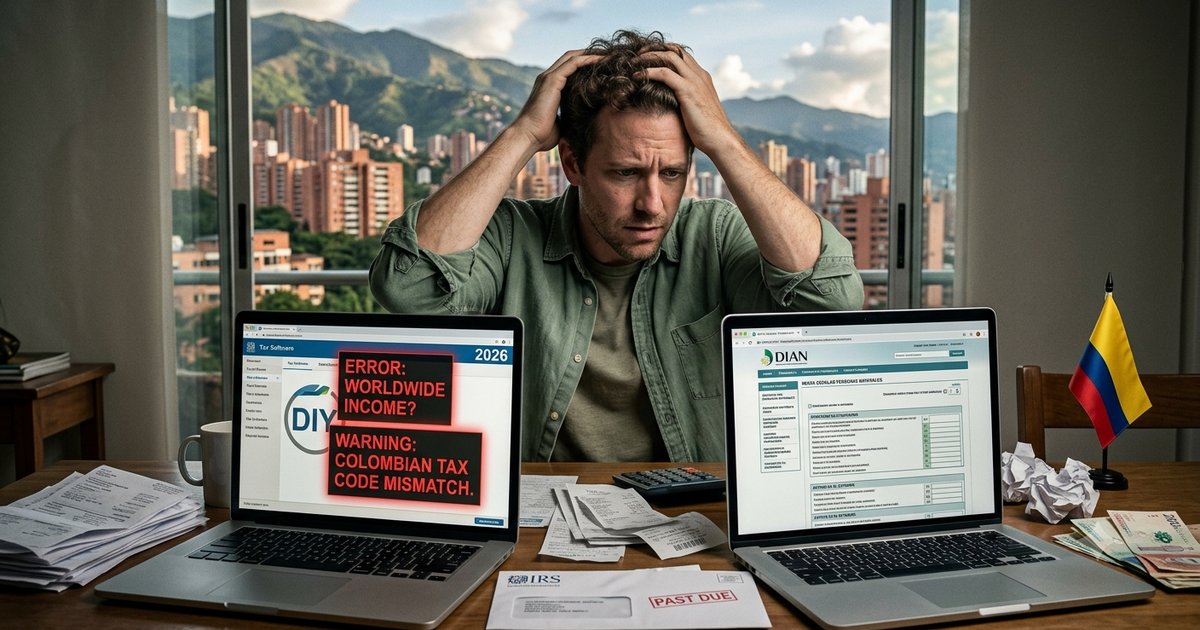

The Worldwide Income Tax Trap
Colombia's 183-day rule pulls your worldwide income into the Colombian tax net once you cross it, not just what you earn locally. This companion guide walks through how the test actually works, why there's no US-Colombia tax treaty to fall back on, and where do-it-yourself research quietly fails. Free, about 10 minutes.
If you spend enough time living between Colombia and somewhere else, you will eventually run into a question that a Facebook group, a Reddit thread, or a general-purpose AI chatbot cannot actually answer for you: am I about to become a Colombian tax resident, and if I am, what does that mean for the income I earn outside Colombia? The honest answer is that it depends on your specific facts, your citizenship, your home country's rules, and how your income is structured, which is exactly why this guide stops short of giving you a personal answer and instead explains the shape of the problem.
The trap nobody explains clearly
Most people who move to Barranquilla for a season, then another season, then start thinking of it as home, never sit down and calculate their day count. They know, vaguely, that Colombia has "some 90-day tourist thing." What they usually do not know is that Colombia's tax residency test is a completely separate calculation from immigration status, uses a rolling window rather than a calendar year, and triggers worldwide income taxation the moment you cross it, not just tax on what you earn inside Colombia.
That gap, between what people assume ("I'm just a tourist, this doesn't apply to me") and what is actually true (barranquilla apartment rentals, remote consulting fees paid to a foreign account, and dividends from a brokerage account back home can all become reportable Colombian income) is where the real financial exposure sits. It rarely shows up in year one. It shows up two or three years later, when someone has quietly crossed the line without noticing, and now has back filings, penalties, and interest to sort out instead of a clean plan from day one.
Colombia's 183-day rule, in plain terms
Under Article 10 of Colombia's Estatuto Tributario, a foreigner becomes a Colombian tax resident for a given tax year if they spend more than 183 days, continuous or not, inside Colombian territory during any rolling 365-day period that ends in that year. A few details trip people up every year:
- It is a rolling window, not a calendar year. Days from the tail end of one year can push you into residency for the next.
- Entry and exit days both count. There is no partial-day exception.
- Any legal status counts the same way. Tourist permit days, visa days, and residency-visa days all add to the same total. Your immigration category does not change the tax math.
- Once you cross 183 days, you are treated as a resident for the entire tax year in which you crossed the threshold, not just the days after day 184.
None of this is unique to Colombia. Most countries with a day-count residency test structure it this way. What catches people is assuming a visa category (the digital nomad visa is the most common example) somehow exempts them from the day count. It does not. A visa is a permission to be in the country. Tax residency is a separate legal question about who taxes your income, and it is answered by counting days, not by checking your visa type.
Worldwide taxation versus territorial taxation
Here is the concept that actually matters for anyone earning income outside Colombia while living inside it. Tax systems generally fall into two broad families:
- Worldwide taxation, where a country taxes its residents on all income earned anywhere on Earth, regardless of where the money was earned or where it is banked. The United States, Canada, most of Europe, and Colombia (once you are a tax resident) all work this way for residents.
- Territorial taxation, where a country taxes only income sourced inside its own borders, and treats foreign-source income as outside its tax net entirely. Panama is the clearest example in this region: Panama-source income is taxed, but income earned from clients, investments, or a business located outside Panama generally is not.
The reason this distinction matters is not that one system is "better" in the abstract. It matters because once you become a Colombian tax resident under the 183-day rule, your worldwide income, consulting fees from a US client, rental income from a Canadian property, dividends from a European brokerage, becomes part of your Colombian tax base. If you have not planned for that, the bill can be a genuine shock, and untangling it after the fact is far more expensive than planning for it in advance.
Why the DIY answers you find online fail
Search "Colombia tax residency" and you will find confident-sounding answers on expat forums, in Facebook groups, and from general-purpose AI assistants. Some of that information is roughly right. A meaningful amount of it is stale, incomplete, or was written for a different person's situation entirely. A few specific ways this goes wrong:
- "Perpetual traveler" advice that ignores the rolling window. A lot of DIY day-count strategies are built around calendar years. Colombia's rule is a rolling 365-day window, so a strategy that looks fine on a calendar-year spreadsheet can still trip the threshold.
- Generic AI answers that cannot see your actual facts. A chatbot does not know your citizenship, your home country's exit rules, whether you have a tax treaty available to you, or how your specific income is structured. It can describe the general rule accurately and still lead you to the wrong conclusion for your situation.
- Confusing "no tax treaty" with "no exposure." The United States, for example, has no tax treaty with Colombia. That does not mean a US person living in Barranquilla is untouched, it means the tools available (the Foreign Earned Income Exclusion, the Foreign Tax Credit) work differently than they would under a treaty, and getting the mechanics wrong is common.
- Treating "I have a Colombian visa" as the answer to a tax question. As covered above, it is not. Visa status and tax residency are answered by two different tests.
None of this means the internet is useless. It means that once real money is at stake, the honest move is to get a second, licensed opinion from someone who can see your actual facts, not just repeat the general rule back to you.
What a legitimate fix actually looks like
For people who are genuinely mobile, splitting real time between Colombia and elsewhere, working with foreign clients, or holding foreign-source income, a compliant structure usually has three ingredients working together, not one clever trick:
- A clear, tracked day count across every jurisdiction you spend time in, kept in real time rather than reconstructed from memory or passport stamps after the fact.
- A second residency base with territorial taxation, held and reported properly, so that foreign-source income has a legitimate home outside Colombia's worldwide-income net instead of drifting into an ambiguous gray zone.
- Licensed, coordinated professional advice on both sides, a Colombian contador who understands foreign-source income, and counsel in whatever second jurisdiction you choose, working from the same set of facts.
This is squarely the territory of general information, not a substitute for that advice. Nothing in this guide is legal, tax, or financial advice, and nothing here should be read as a conclusion about your specific situation. Tell Catalina your situation and she'll connect you with a licensed Colombian contador and, where relevant, a professional in your home country and in any second jurisdiction, before you make decisions based on your day count or your income structure.
Getting this looked at properly
Coordinating a cross-border structuring and residency plan properly means bringing together licensed local partners, an attorney, a CPA, and immigration counsel, working from the same facts rather than each seeing a piece of the picture. Firms that do this work well tend to bundle corporate structuring, residency, banking, and ongoing tax filing into one coordinated engagement instead of leaving you to manage three separate advisors across two countries yourself.
If you want a straight answer about whether your situation actually needs a structure like this, or whether a good Colombian contador alone is enough, tell Catalina what's going on and we'll point you toward the right kind of help, no names or specifics required to start.
FAQ
Does having a Colombian visa mean I am automatically a tax resident?
No. Visa status and tax residency are two separate legal questions. The 183-day rolling-window test decides tax residency regardless of which visa, or no visa at all, you are holding.
If my home country has no tax treaty with Colombia, does that mean I am taxed twice?
Not automatically, but it does mean the relief mechanisms work differently. A US person, for example, relies on the Foreign Earned Income Exclusion and the Foreign Tax Credit rather than a treaty. Get advice specific to your citizenship before assuming either outcome.
Is a "Plan B" second residency the same thing as tax evasion?
No, and treating it that way is exactly the mistake to avoid. A properly disclosed second residency, reported correctly in every jurisdiction involved, is a legitimate planning tool. What crosses the line is failing to disclose accounts, income, or ownership where disclosure is legally required.
Where can I read more about the specific day-count mechanics?
See Tax Residency in Colombia: The 183-Day Rule for the detailed breakdown of Colombia's brackets, DIAN filing process, and the specific mistakes that catch remote workers.
Related reading on this topic: Building a Real Plan B: Panama Residency for People Living in Colombia, When a Remote Contractor Actually Needs a Panama Company, Asset Protection and Succession Planning with a Panama Foundation.
Still have questions?¿Todavía tienes preguntas?
Catalina is our concierge. Ask her about visas, neighborhoods, healthcare, prices, anything Barranquilla. She answers in chat or WhatsApp, English or Spanish, free.Catalina es nuestra concierge. Pregúntale sobre visas, barrios, salud, precios, cualquier cosa de Barranquilla. Responde por chat o WhatsApp, en inglés o español, gratis.
Chat with Catalina ›Habla con Catalina ›